- Multiplier in a Minute
- Posts
- What Role Do Sponsorships Have In An AI World?
What Role Do Sponsorships Have In An AI World?

Kern Egan
March 13, 2026
My algorithm says we’re cooked. Thanks, AI.
Maybe we are. But there are also opposing views (“taste is the new currency,” flight to IRL experiences, etc.), so I wanted to explore for myself how AI might affect my industry (sports and entertainment marketing).
Here’s the first hypothesis we tested at Multiplier:
If the internet becomes more governed by LLMs and “answer engines,” we could question what that means for brands’ marketing budgets going forward:
a simple reallocation of digital budgets or, more consequentially for some,
an incremental investment in AI optimization at the expense of real-world channels (e.g., out-of-home, events, sponsorships).
The case for the latter: A new interface means new behavior, which means new optimization tactics, and clicks/attribution getting murkier can push marketers even harder toward whatever feels measurable (and in more real time).
But here’s what could happen:
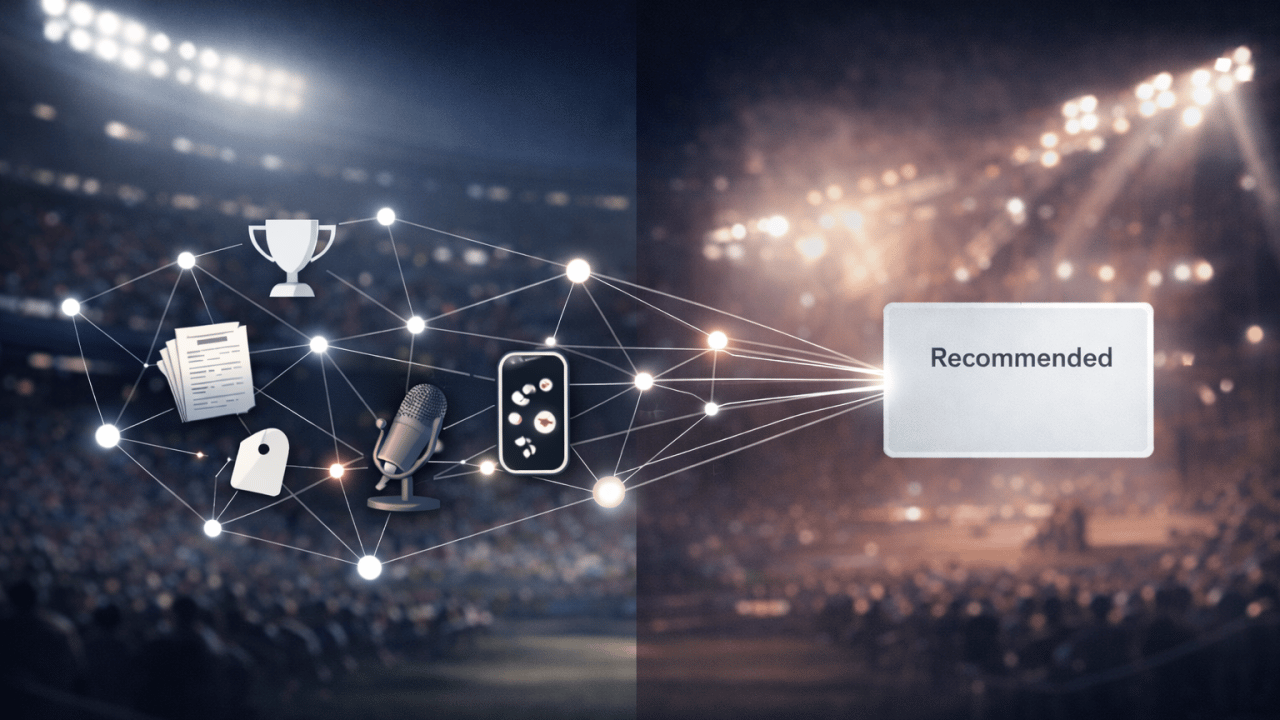
Cultural relevance becomes a ranking input.
LLM models might not necessarily have “taste,” but they can draw on culture to produce the kind of third-party proof these systems rely on when deciding what to recommend.
Example:
If an LLM is trying to help someone choose the “best performance tire,” it’s not only pulling reviews and specs. It’s also absorbing the proof points around brands.
So, Firestone showing up in and around INDYCAR matters. Not just because it has millions of fans to engage, but because it creates a constant stream of credible association between Firestone and performance, engineering, speed, compounds, racing, and pressure-tested outcomes that is organic to an elite motorsport.
Same question, but for non-endemic sponsorships:
Sticking with the category, if an auto brand shows up everywhere in and around the PGA TOUR, does that help position it as “luxury” in AI answers?
Maybe. But only if the association turns into language the machine can actually use.
Golf signals affluence. Affluence signals luxury. But “luxury” doesn’t stick unless the ecosystem produces explicit proof of premium: craftsmanship, pricing, materials, experience, comparisons, and a trusted group of luxury buyers (i.e., golf fans) who say what’s historically been left to critics. You can draw similar parallels in entertainment.
The new game might be less “how do we show up more,” and more “how do we earn repeatable credibility that shows up everywhere else.”
The fastest path for brands might look like a three-part engine:
Rights-holder proximity Partnerships (sponsorships) are more important than ever, but the activation brief starts with: What proof points can the partnership help us consistently manufacture to reinforce the brand equities we’re paying to associate with?
Creator proof This is less “one big creator post” so you can highlight the impressions in your recap deck. More like a bench of influential fans who explain, compare, test, translate, or take whatever actions are necessary to translate the message to the audience.
Community proof Focus where real fans live. Fantasy leagues (Sleeper), gear forums (GolfWRX), sneaker boards (NikeTalk), film discourse (Letterboxd), message boards (TexAgs), subreddits (r/radiohead – seriously, it’s a thing), and, of course, group chats. Where real conversation happens, and you can’t fake it and have to earn it.
The irony is what appealed to me. The idea that…
IRL investment in culture can be an amplifier of AI distribution rather than a tradeoff.
The internet – and specifically social – catapulted cultural relevance into the spotlight (remember Ellen’s first selfie at the Academy Awards 12 years ago?). Culture is how the internet decides what’s not only interesting but credible. AI is just making that decision faster and more concentrated.
If you’re a brand marketer or agency leader in the space, a practical question to ask:
What do we want to be recommended for, and where is the proof coming from?
If the evidence is thin, no amount of “AI optimization” will save you.
If the proof is everywhere, AI will do what it always does. It will summarize the world’s opinion and hand it back to consumers.
Our collective job is to influence the world’s opinion, and integrating the brand into culture in a way that matters to people is a cheat code in our AI era.
Want to know more? Hit us up at [email protected] or give us a shout on our socials.